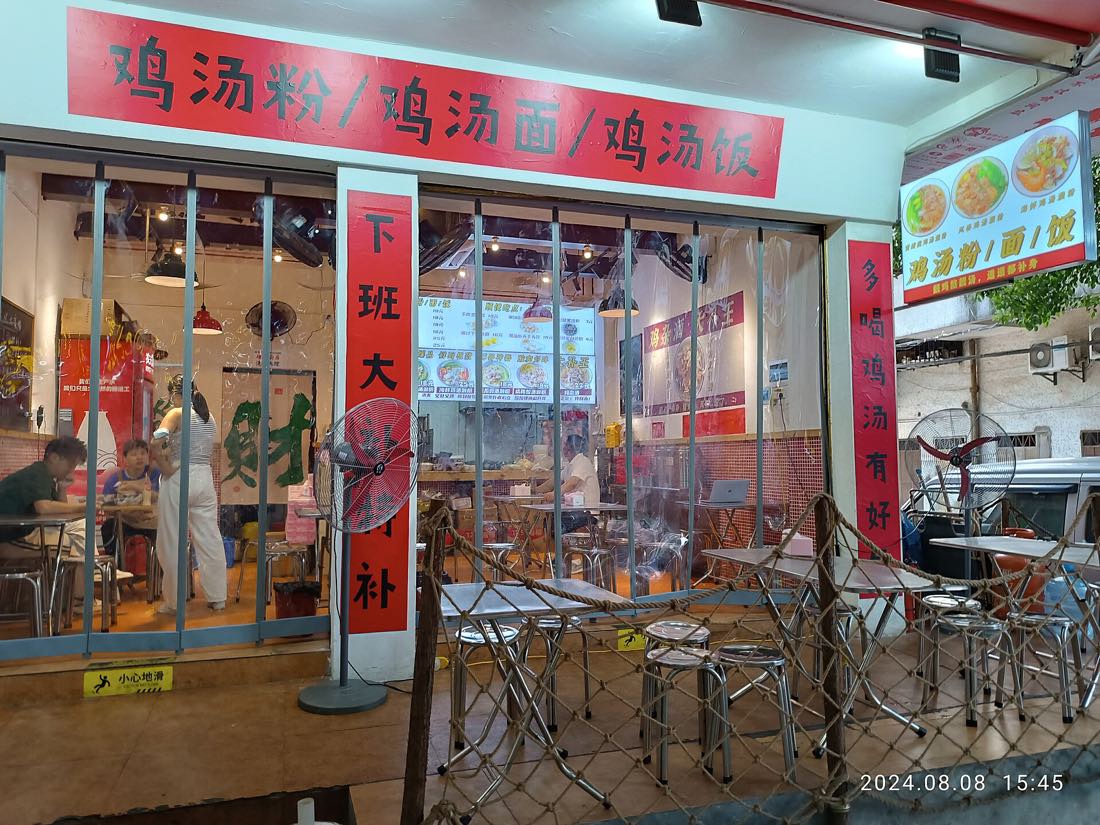
Where Locals Actually Eat:
The Formats, Decoded
The barrier to eating well in Guangzhou is not money — a good meal is ¥25 — it is knowing which door to walk through. Four formats cover almost everything: the 茶楼 tea house (morning tea, ¥30–180), the 冰室 ice room (a surviving Hong Kong-style café format — 顺记 on Baohua Road does coconut ice cream at ¥30–40), the neighbourhood 大排档 (open-front, wok-fired, loud, ¥40–80), and the mall food halls in Tianhe where the stars live at another price entirely. The tool that makes all of it navigable is Dianping 大众点评 — Chinese-only interface, but a 4.5+ rating is the local quality filter and camera translation handles the rest.
Which door to walk through
| Format | What it is | Typical ¥pp | When |
|---|---|---|---|
| 茶楼 tea house | Morning tea — a leisure meal, tick-sheet or mini-program ordering | ¥30–180 | 07:00–11:00, plus 夜茶 evenings |
| 冰室 ice room | The surviving HK-style café: milk tea, toast, ice cream, cheap set meals | ¥20–50 | All day, closes ~21:00 |
| 大排档 / neighbourhood 食肆 | Open-front, wok-fired, plastic stools, no English | ¥40–80 | Lunch and 18:00–late |
| 糖水铺 dessert house | Tong sui — the 21:00–24:00 social outing | ¥10–32 | Late evening |
| 粥粉面 congee-noodle shop | The everyday breakfast and late-night format | ¥15–30 | Early and very late |
| Mall dining, Tianhe | Taikoo Hui, Parc Central, Grandview, K11 — stars and hotel rooms | ¥150–500 | Dinner |
The corridors worth walking: 同福路 (Haizhu) · 龙津路 (Liwan) · 西华路 (Liwan) · 宝华路 (the ice-room street) · 文明路 (the best of all) · 东山口 (coffee and brunch) · Binjiang East and Jiangnanxi in Haizhu, which are dense, entirely local and have effectively zero tourists.
Chaoshan is the fastest-growing serious food in Guangzhou
Cantonese is the house language, but Chaoshan (Teochew) is the strongest non-Cantonese presence in the city and arguably its fastest-growing serious cuisine. At the top: 御宝阁 (one Michelin star), 岁集院子·拾月 (one star and Black Pearl), 潮跃 (Black Pearl), 咏作 (2025 Bib, Teochew congee), 南园酒家 (Bib), and 赏鲜悦木, a Chaoshan beef hotpot house that took a new Black Pearl diamond in 2026.
What to order: 牛肉火锅, beef hotpot cut by muscle group — 吊龙, 匙柄, 五花趾, 脖仁 — each with its own prescribed dip time in seconds, which is not affectation but the whole technique. 卤鹅, braised goose, using 狮头鹅, the largest goose breed in the world. 蚝烙, oyster omelette. 工夫茶, the thimble-cup tea service that punctuates every Chaoshan meal.
One caution: 生腌, raw-marinated shellfish — nicknamed "Chaoshan poison" for how addictive it is — has been intensely fashionable since 2024. It is also raw shellfish, and it carries the food-safety risk raw shellfish carries anywhere. Good houses handle it well; street versions are a gamble.
Sichuan and Hunan punch above expectation at the top end too: 宋 Song (one star), Yong (one star plus the Green Star), 宋-湘 (Selected) and 田间湘食 (Bib). Hunan is the fastest-growing cuisine in China nationally, and Guangzhou is no exception.
Five habits that make it work
4.5+ is the local threshold. The interface is Chinese-only; the star rating is not, and it is the single most reliable signal in the city.
Entirely normal here. Nobody minds, and it bypasses the menu problem completely.
Roughly 40% of Guangzhou restaurants are QR-menu-only, and the mini-programs are Chinese-only. Camera translation inside Alipay handles most of them.
老火汤 is served before the meal, not after — the opposite of Western practice, and one of the deepest habits in Cantonese eating.
A 5–10% service charge at sit-down restaurants is normal and is not a tip. Nothing extra is expected or wanted.
Questions people actually search
How do you find good restaurants in Guangzhou without Chinese?
Dianping 大众点评 with camera translation. The app is Chinese-only but ratings are universal, and 4.5+ is the local quality bar. Filter by distance, sort by rating, screenshot the address in characters and show it to a DiDi driver — that workflow solves nearly every meal.
What is a normal price for a meal in Guangzhou?
¥25 (about $3.50) for a good cheap local meal, ¥50–80 per person for dim sum at a neighbourhood tea house, ¥100–200 for dinner for two at a solid restaurant, ¥250–500 per person at Bing Sheng or a Michelin one-star. Guangzhou's food is not expensive at any tier — the famous rooms are the exception, not the rule.
What is a dai pai dong?
大排档 — the open-front neighbourhood restaurant with plastic stools and a wok line you can see from the street. Loud, fast, cheap (¥40–80 a head) and where a lot of the best everyday cooking in Guangzhou happens. Look for full tables and a visible kitchen.
Is Chaoshan food different from Cantonese?
Yes, meaningfully. Chaoshan (Teochew) cooking comes from eastern Guangdong and is its own tradition: beef hotpot cut by muscle group, braised goose, oyster omelettes, raw-marinated shellfish and gongfu tea. It is the fastest-growing serious cuisine in Guangzhou and holds several of the city's Michelin stars and Black Pearl diamonds.