Xiaobei’s Kitchens:
The Other Guangzhou
Xiaobei is one of the best eating neighbourhoods in Guangzhou and completely unlike anything else in the city — Uyghur, Turkish, Yemeni, Nepalese, Indian and West African kitchens within a few blocks, at ¥40–80 per person. Two practical facts decide whether you find any of it: the live hours are 19:00–23:00, and many of the best places are upstairs in commercial buildings with no street presence. You have to go up. Metro Line 5 → Xiaobei, Exits A or B. Cash and Alipay/WeChat both work. And be straight about what this is: a working quarter where people trade and live, not an attraction — the etiquette section below is not decoration.
What to eat, and where
| Kitchen | Where | Order | ¥ |
|---|---|---|---|
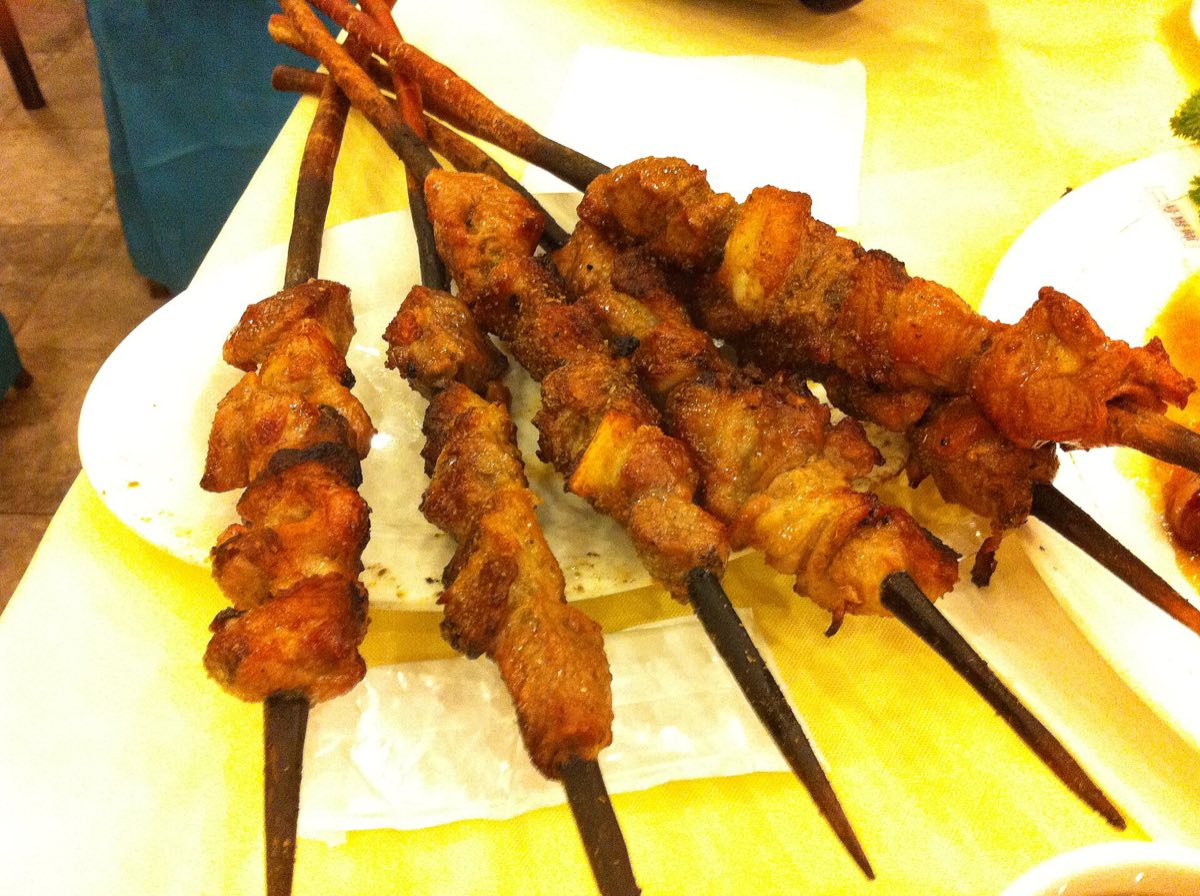
| Uyghur / Xinjiang The strongest and most durable presence | Across the quarter | Lamb kawap skewers, tandoor naan, dapanji big-plate chicken, lagman hand-pulled noodles, grilled leeks and aubergine | ¥40–80pp |
| Turkish — Ankara Restaurant | Upper Baohan Zhijie | Hummus ¥22, mutton kebabs ¥50, ayran ¥18 | ¥50–90pp |
| Yemeni — Hadramout | 3F, New Honghui Wholesale Market | Fattoush ¥30, grilled lamb ¥40–70, free spiced lentil soup | ¥50–80pp |
| Nepalese — Namaste Kitchen | Xiaobei | All-you-can-eat ¥50–55, momos | ¥50–55 |
| Indian — Sharma Ji est. 1999, Guangzhou's first | Xiaobei | Paneer tikka ¥40, masala dosa ¥45, buffet ¥60–70 | ¥40–70pp |
| West African — Moustache Bar | Xiaobei | Fufu ¥15, fried plantains ¥15, suya, grilled fish | ¥40–70pp |
| West African — African-Pot | 2F Tongtong Trade City, Wangshengtang, Baiyun | Main + side + soup ~¥55 | ~¥55 |
Two honest notes. The West African places are the most fragile — the fewest remain, and they change names and locations frequently, so ask locally rather than relying on any list including this one. And there are more halal and Middle Eastern restaurants here than genuinely African ones; many venues advertise "African, Turkish, Indian, Pakistani" simultaneously, which is a business decision rather than a menu.
The etiquette, stated plainly
The best kitchens are on the second and third floors of commercial buildings with no street signage. If a doorway has a stack of menus taped inside it, that is the door.
This is a trading district at trading hours. Be a customer — order, eat, pay, tip nothing (nobody expects it) — and you are entirely welcome.
The community has had a documented rough decade, including the 2020 discrimination episode. A lens raised uninvited lands badly and reasonably so. Photograph the food.
If the appeal is the food and the five languages crossing a junction, come. If it is looking at people, don't.
19:00–23:00 is when the quarter eats. QR works nearly everywhere, cash works everywhere.
Why this food is here at all
Not an accident of the 2000s. The nearby Xianxian Ancient Mosque holds the tomb attributed to Sa'ad ibn Abi Waqqas, a companion of the Prophet, and Muslim traders have worked this part of Canton for roughly 1,300 years. The halal infrastructure the modern trading community plugged into was already here — which is why Uyghur and Middle Eastern kitchens established faster and have proved more durable than the West African ones.
The quarter is quieter than it was in 2013–19: Arabic signage has been largely removed under signage standardisation, and the resident population fell sharply between 2014 and 2020 for reasons that were mostly currency and trade economics rather than policing. Our district page lays out what is actually documented, including why the "100,000 Africans in Guangzhou" figure is a myth. Quieter is not gone, and the eating remains excellent.
Questions people actually search
Where do you find African food in Guangzhou?
Around Xiaobei (Metro Line 5, Exits A/B) and Wangshengtang in Baiyun, mostly in the evenings and mostly upstairs in commercial buildings. Moustache Bar and African-Pot are the named survivors, but this is the most fragile part of the quarter — venues change names and addresses often, so ask on the ground rather than trusting a published list.
Is Xiaobei good for halal food?
It is the best halal eating in Guangzhou by a distance — Uyghur, Turkish and Yemeni kitchens concentrated in a few blocks, at ¥40–80 a head. That concentration traces back roughly 1,300 years to the trading community around the Xianxian Ancient Mosque, not to the last two decades.
What time should I go to Xiaobei to eat?
19:00–23:00. Daytime is wholesale freight and shutters; the quarter comes alive in the evening. Line 5 to Xiaobei, Exits A or B, and start on Baohan Zhijie.
Is it appropriate to visit Xiaobei as a tourist?
As a customer, yes — eat, shop, pay, be normal. As a spectator, no. The community has been photographed and written about badly for years, including through a 2020 episode of documented discrimination. Don't photograph people without asking, and treat it as a neighbourhood rather than an exhibit.