Shamian Island: Is It Worth Your Morning? (2026)
A sandbank cut off by a canal in 1859 and handed to Britain and France as a concession. What is left is 150-odd European buildings on 0.3km² of car-light streets under banyans — free, open at any hour, carrying two histories nothing in English tells you.
Shamian costs nothing, never closes, and delivers more per step than anywhere else in Guangzhou — 0.3km² holding over 150 preserved European buildings, including an 1892 chapel, an 1865 church and the 1916 customs house. It is also the city's number one wedding-photography location, which means the light hours are crowded with couples and tripods rather than tourists. Come 07:00–09:00 or 16:00–18:00, walk the whole island in ninety minutes, and combine it with Yongqingfang or a Xidi wharf cruise rather than treating it as a half-day on its own.
A sandbank that was cut off from China on purpose
Shamian means sandy surface. It was a riverside customs post until the aftermath of the Second Opium War, when the Qing government formalised its transfer between 1859 and 1861 — roughly four fifths to Britain, one fifth to France.
The concession was engineered to be separate. A canal was dug along the northern edge so the island could be sealed by two bridges, and for decades Chinese residents were restricted from it. What that produced is a street plan nothing like the rest of Guangzhou: five parallel avenues, a central garden spine, low building density and banyan trees old enough to arch across the road.
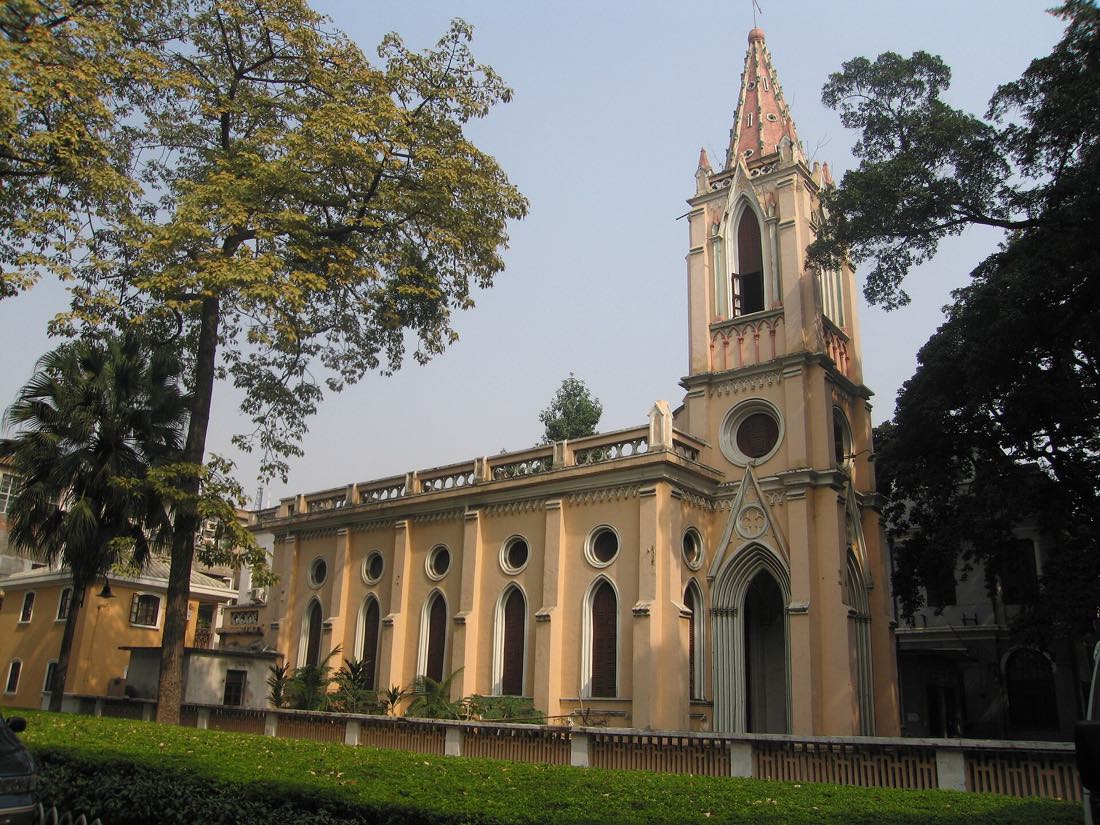
More than 150 European buildings survive — consulates, trading houses, banks, churches, residences — in a compressed range of styles from the 1860s to the 1920s. The ones to actually look at are Our Lady of Lourdes Chapel (French, 1892), Christ Church (Anglican, 1865), the former HSBC building of 1887, and the 1916 Big Clock Tower on the north side, which now houses the Guangdong Customs Museum.
The island carries one hard piece of history that its current use as a wedding backdrop tends to erase. On 23 June 1925, British and French troops fired on a demonstration crossing from the Shakee bund opposite, killing dozens of Chinese protesters. The Shakee Massacre is commemorated on the island's southern edge, and it is part of why the concession's end is remembered here as a reclamation rather than a handover.
Today it is Guangzhou's number one wedding-photography location by a distance. On a good weekend morning you will pass dozens of couples, crews and reflector boards. It is genuinely charming for about twenty minutes and genuinely obstructive after that, which is the main argument for the 07:00 hour.
Shamian was the last stop of American adoption from China
For about twenty years this island was the final address in one of the largest international adoption movements in modern history, and you will not find that on a single competing guide to Guangzhou.
From the 1990s until around 2015, the US Consulate on Shamian processed every American adoption immigrant visa for China — every family, from every province, ended their adoption here. The White Swan Hotel on the island's southern shore became the default place to stay, close enough to the consulate to walk, and it absorbed the role completely: a shop selling formula and clothes in American sizes, staff who knew the paperwork better than the parents did.
What grew out of that was the red couch tradition — families photographing their newly adopted daughters together on a red sofa in the White Swan lobby, the same couch, year after year, until the images formed an accidental archive of an entire era of migration. Adoption volumes from China peaked in the mid-2000s and fell sharply after 2007, when the eligibility rules tightened. The consulate moved off the island in 2013 to Zhujiang New Town, and China ended foreign adoption almost entirely in 2024.
So if you are here and you are wondering why an island in southern China has a quiet steady stream of American visitors in their teens and twenties, some of them visibly retracing something — that is why. Several thousand people a year came home through this street. It is the single most interesting thing about Shamian and it is completely undocumented in travel writing.
Is Shamian Island for you?
Shamian Island, practically
Guided walks that make the island legible
Nothing here is ticketed, so a tour is buying interpretation rather than access — and on an island where almost every building is unlabelled and the best story is not written down anywhere, that is a reasonable thing to buy.
Shamian Island questions
Is Shamian Island free?
Yes, entirely. There is no gate, no ticket and no closing time — it is a residential and commercial district you walk into across a footbridge. The only things you can pay for are the cafés, the Guangdong Customs Museum in the clock tower, and a drink at the White Swan.
How do you get to Shamian Island?
Metro Line 1 or Line 6 to Huangsha, Exit B, then across the short footbridge over the canal. The same station serves Yongqingfang and the Xidi cruise wharf, which is why this corner of Liwan is the most efficient half-day in the city.
How long do you need on Shamian Island?
Ninety minutes covers the five streets at a walking pace with stops. Three hours is right if you add the Customs Museum, a coffee and the riverfront path. It is 0.3km² — you cannot get lost and you cannot miss much.
What is the best time to visit Shamian?
07:00 to 09:00 or 16:00 to 18:00. Those are the two light windows, and the early one also gets you ahead of the wedding photography crews, who occupy the best doorways and colonnades from mid-morning onward at what is the city's most popular bridal location.
What is the White Swan Hotel's connection to adoption?
From the 1990s to around 2015 the US Consulate on Shamian processed every American adoption immigrant visa issued in China, and the White Swan became the hotel where those families stayed. The lobby's red couch photographs became a tradition. Volumes fell sharply after 2007, the consulate left in 2013, and China ended foreign adoptions almost entirely in 2024.
Is Shamian worth visiting if I have seen European cities?
Yes, but for a different reason than you expect. The interest is not that the buildings are European — it is that they are a sealed treaty concession with a canal dug around it, sitting inside a Chinese city, and that the story of how it ended is still commemorated fifty metres from where the couples are posing.
Can you eat well on Shamian Island?
Not especially. The island's restaurants are priced for the view and the White Swan's dim sum runs around ¥400 a head for what a good neighbourhood tea house does for ¥50–80. Walk ten minutes north into Xiguan instead — the food improves immediately and the price halves.